
In a high-stakes laboratory or medical environment, ice is more than a cooling agent; it is a critical tool for sample preservation, chemical reaction control, and patient rehabilitation. Unlike the hospitality industry, where aesthetics and melt rates are the focus, laboratory ice machines must prioritize biological purity, temperature stability, and physical adaptability.
At HuaChill, we’ve spent years refining our 2026 Med-Tech series to meet the rigorous demands of hospitals and research facilities. In this guide, we will analyze the technical requirements for medical grade ice makers and why Flake ice is the preferred medium for scientific applications.
Table of Contents
- 1. Why Flake Ice is the Gold Standard for Science
- 2. The 3 Non-Negotiables of a Medical Grade Ice Maker
- 3. Diverse Applications: From Pharmacies to Physio
- 4. Technical Comparison: Lab-Grade vs. Food-Grade
- Conclusion: Reliability You Can Trust
1. Why Flake Ice is the Gold Standard for Laboratory Ice Machine Performance
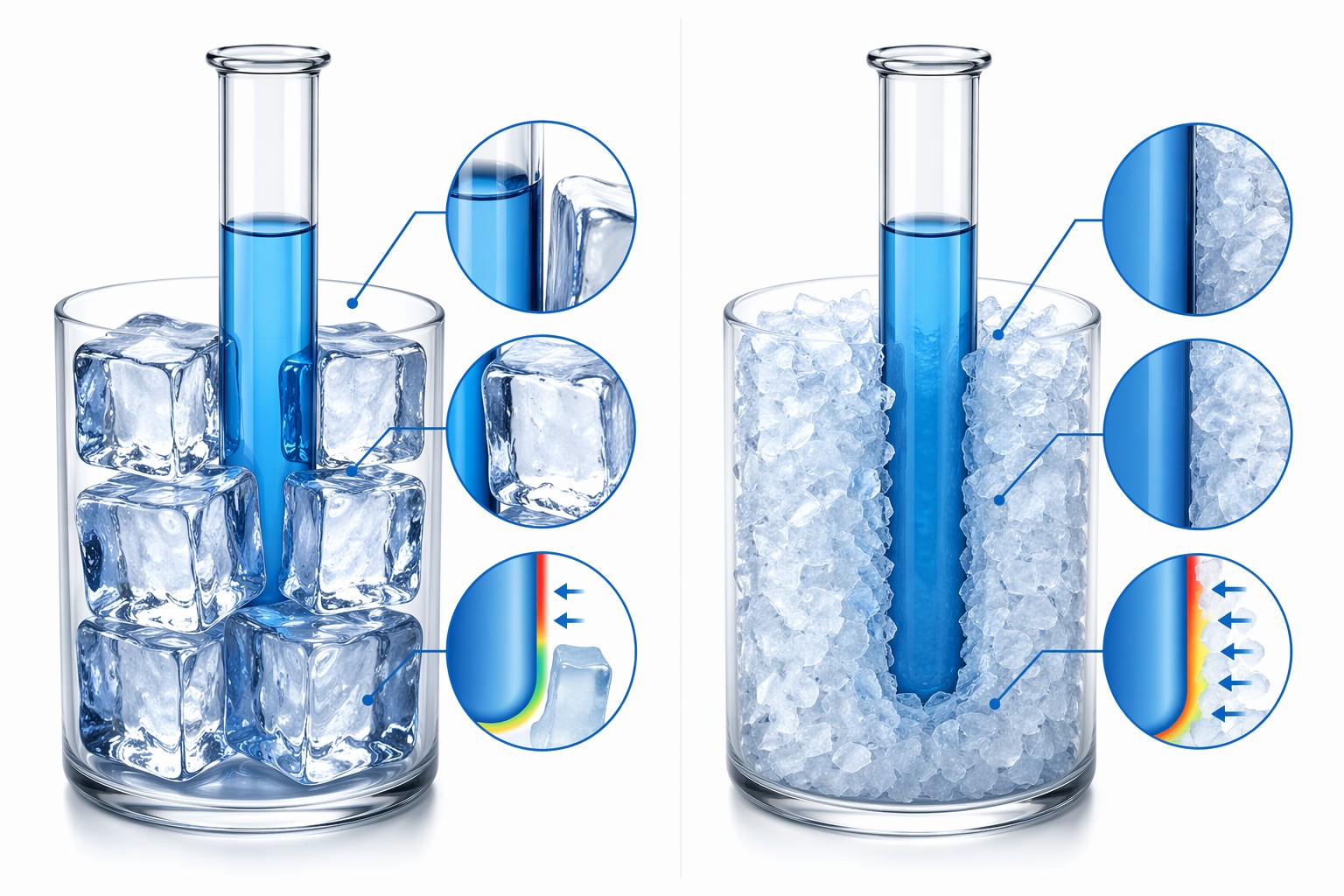
Most laboratories exclusively use Flake ice rather than cubes. The reasoning is rooted in physics:
- Maximum Surface Area: Small, thin flakes mold perfectly around test tubes and sample containers, ensuring 100% contact and rapid, even cooling.
- Softness: Flake ice won’t scratch delicate glass or plastic lab-ware.
- Stationary Stability: Unlike cubes that slide, Flake ice creates a stable “bed” that keeps samples upright even as the ice melts.
2. The 3 Non-Negotiables of a Medical Grade Ice Maker
When procuring an ice machine for hospitals or clinics, these three features are critical for safety and compliance:
I. Anti-Microbial Interior
Stagnant water is a breeding ground for biofilm. HuaChill’s 2026 medical units feature Ag+ Ion silver-based liners and built-in UV-C sterilization modules to eliminate 99.9% of bacteria before the ice is formed.
II. High-Precision Consistency
In a laboratory setting, “slushy” or wet ice can introduce temperature fluctuations that ruin an experiment. Our machines use sub-zero evaporation technology to produce “dry” flake ice with a temperature of roughly -0.5°C (31°F), ensuring long-term thermal stability.
III. Reliable Quiet Operation
In a hospital hallway or a quiet research wing, a loud compressor is a major disruption. HuaChill medical units are engineered with vibration-dampening mounts and insulated cabinets to operate at near-silent decibel levels.
3. Diverse Applications: From Pharmacies to Physio
Where does a HuaChill medical grade ice maker earn its keep?
- Tissue Transport: Keeping biological samples at a precise temperature during transit between departments.
- Physical Therapy (Cryotherapy): Providing soft, moldable ice for post-surgical swelling and sports injury recovery.
- Pharmacy Storage: Maintaining the temperature of temperature-sensitive vaccines and medications.
4. Technical Comparison: Lab-Grade vs. Food-Grade
| Feature | Food-Grade (Hospitality) | Med-Tech Grade (HuaChill) |
|---|---|---|
| Sanitation | Standard Cleaning Cycle | Integrated UV-C & Ag+ Ion |
| Ice Temperature | 0°C (Standard) | -0.5°C to -1°C (Sub-cooled) |
| Noise Level | 60-70 dB | < 45 dB |
| Filtration | Carbon (Taste/Odor) | High-Efficiency Antimicrobial |
Conclusion: Reliability You Can Trust
In science, there is no room for error. A failure in your ice production could mean months of lost research or compromised patient care. Investing in a HuaChill Med-Tech series ensures that your facility has a reliable, pure, and consistent source of ice 24/7.
Looking to equip your facility?
Request a Technical Spec Sheet or Speak with our Medical Equipment Consultant for a customized laboratory layout.
Frequently Asked Questions: Laboratory Ice Machine Selection
Q: How often should I clean my laboratory ice machine?
A: To maintain biological purity, a laboratory ice machine should be deep-cleaned at least every 6 months, though monthly inspections are recommended for high-use medical facilities.
Q: Can I use regular tap water in my laboratory ice machine?
A: While possible, using a high-efficiency antimicrobial filter with your laboratory ice machine ensures that the flake ice remains pure and free of mineral scale that could damage the evaporator.
Q: What is the ideal capacity for a hospital laboratory ice machine?
A: Most research labs find that a laboratory ice machine with a daily production capacity of 50kg to 150kg is sufficient, but larger hospitals may require industrial-scale units.
Q: Is flake ice better than nugget ice for medical use?
A: Yes, for scientific cooling, a laboratory ice machine producing flake ice is superior because it provides more surface area contact for test tubes than nugget ice. For more details, see our Commercial Ice Types Guide.
Choosing a laboratory ice machine requires careful consideration of technical specs. Our laboratory ice machine guide covers all the essentials.
—
Looking for technical manuals, installation advice, or expert troubleshooting for this model? Explore our comprehensive Technical Support guide.